
What’s the difference between AMTA and CAMTC?
AMTA Clarifies Position on California Assembly Bill 1703
Dear California Massage Community,
AMTA is responding to recent communications about California Assembly Bill 1703 (AB 1703) that incorrectly describe our position and involvement with the legislation.
On September 1, 2026, the California Massage Therapy Council (CAMTC), through its Director of Government Affairs, Beverly May, distributed an email stating that AMTA told the California legislature on August 5 that "the bill as currently written is sufficient" and "there is no need to further clarify the definition of massage therapy."
This characterization is incomplete and misleading.
From the beginning, AMTA has consistently maintained the following position:
AB 1703 should not interfere with lawful massage therapy practice, and any uncertainty in the bill should be addressed through clarifying language that protects all massage therapists who are lawfully practicing in California.
CAMTC's communication omitted critical context and failed to acknowledge AMTA's efforts to secure language protecting all legally practicing massage therapists in California, not just those who hold CAMTC certification.
AMTA's Work on AB 1703
AMTA has actively participated in multiple conversations and email exchanges with the bill sponsor, the author's office, legislative staff, the committee consultant, and all stakeholder lobbyists. At no point did AMTA submit a formal position stating that no clarification was needed.
Key Events
July 29, 2026
AMTA's Concerns
July 30, 2026
AMTA continued discussions with the sponsor and worked to find a solution that would protect all massage therapists while avoiding potential unnecessary restrictions.
August 3, 2026
AMTA informed the sponsor that it would seek an independent review from the committee consultant.
August 4, 2026
The committee consultant confirmed AMTA's concern that protecting only CAMTC-certified therapists could be problematic because California lacks a defined statewide scope of practice for massage therapy.
The consultant discussed the issue with the sponsor and author.
As a result, all parties, including CAMTC, agreed that broader language would be more appropriate.
The CAMTC-specific language was then removed and replaced with language that protects massage therapy services authorized under California law.
The final language agreed to by both AMTA and CAMTC states:
"Nothing in this paragraph shall prohibit the practice of a California healthcare licensed profession or massage services authorized by California law."
In addition, the sponsor agreed to delay implementation of the bill until January 1, 2028.
AMTA's Consistent Effort to Protect All Massage Therapists
CAMTC's recent communication presents AMTA's August 5 statement without the broader context of the discussions that led to the final bill language. On that same day, AMTA informed its members that it did not believe AB 1703 would adversely affect qualified massage therapists practicing lawfully in California. In addition, we explained that we had proposed clarifying language to ensure the bill would not create unintended consequences for massage therapists.
AMTA's position remained consistent throughout the legislative process. Our focus was protecting all massage therapists lawfully practicing in California, not only those who hold a voluntary CAMTC certification.
Because California does not have a statewide massage therapy license or statutory scope of practice, we could not support language that might create different legal protections based solely on certification status. Instead, we worked with legislators and staff to secure broader language protecting massage services authorized under California law while preserving the distinction between massage therapy and OMT.
AMTA's Request for Correction
We expect organizations communicating with the massage therapy profession to provide clear and accurate information about legislative issues. CAMTC’s description of our August 5 communication does not provide the full context, correctly reflect AMTA’s position, or recognize our efforts to protect all massage therapists legally practicing in California. We respectfully ask CAMTC to revise and resend its communication to accurately reflect that AMTA did seek clarifying language in AB 1703. AMTA remains committed to constructive legislative engagement, fact-based dialogue, and advancing policies that support and protect the massage therapy profession. Throughout this process, our focus has been on ensuring that every massage therapist lawfully practicing in California is treated fairly and afforded equal protection under the law, regardless of certification status. We are proud to advocate for the entire profession and will continue working to preserve opportunities for massage therapists to serve their clients, communities, and the health and well-being of Californians. As always, please reach out to our Government Relations Team with any questions.
Respectfully,
Jeff Flom
AMTA Chief Executive Officer
Government Relations Update
March 2026
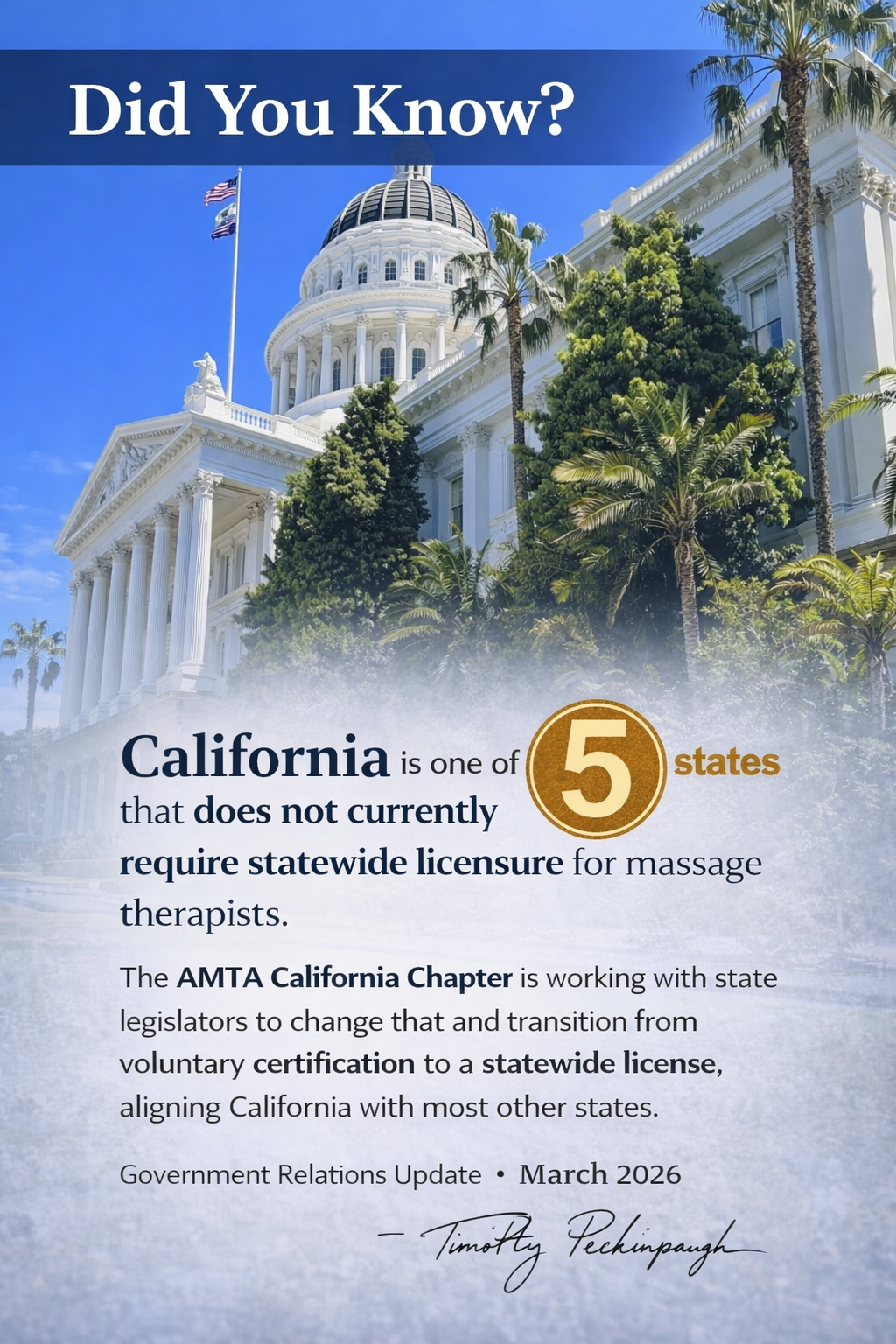
Our Work Towards Licensure Continues
Your AMTA California team is working to secure an author for our bill to transition California from a voluntary certification system to a mandatory statewide license for our profession. Several legislators have expressed interest in carrying the bill, and we are working to ensure we find the right fit. Because a spot bill has been introduced, we have an extended deadline to secure an author for this legislative session.
Licensure Offers Three Key Benefits
The current voluntary certification model offered by the CAMTC cannot achieve these goals.
Frequently Asked Questions About Licensure
-
No. Our bill includes generous legacy provision that will automatically transition currently certified therapists into the new licensing system.
-
You will still be eligible to be automatically transitioned. The bill provides multiple pathways to licensure, including demonstrating professional practice history (such as three years of professional massage therapy experience) or membership in good standing with a recognized professional organization like the American Massage Therapy Association.
-
We anticipate the fees being similar to what we currently pay for our voluntary certification fees. We are looking at licensing board fees from similar fields, such as the acupuncture board, to model the fee structure.
What’s Next In the coming months
A long-awaited update on our Government Relations efforts towards state licensure for massage therapy
Currently, there is a spot bill* on the Massage Therapy Act (AB 1757). (A "spot bill" is a placeholder piece of legislation introduced by lawmakers—commonly in the California Legislature—that makes no substantive changes to existing law. It holds a "spot" to meet introduction deadlines, allowing the author to insert substantive, often complex, language later through amendments.)
Our team is currently still shopping for an author for a bill to propose a change to the current Massage Therapy Act from a voluntary certification to a mandatory state license. While we do have some possible interested candidates, we do not have a commitment yet. It is very important that we have the right person to lead and author this bill, since it can very much determine whether or not a bill will succeed or die on the floor.
We will keep you updated as we proceed.
What Are We Doing?
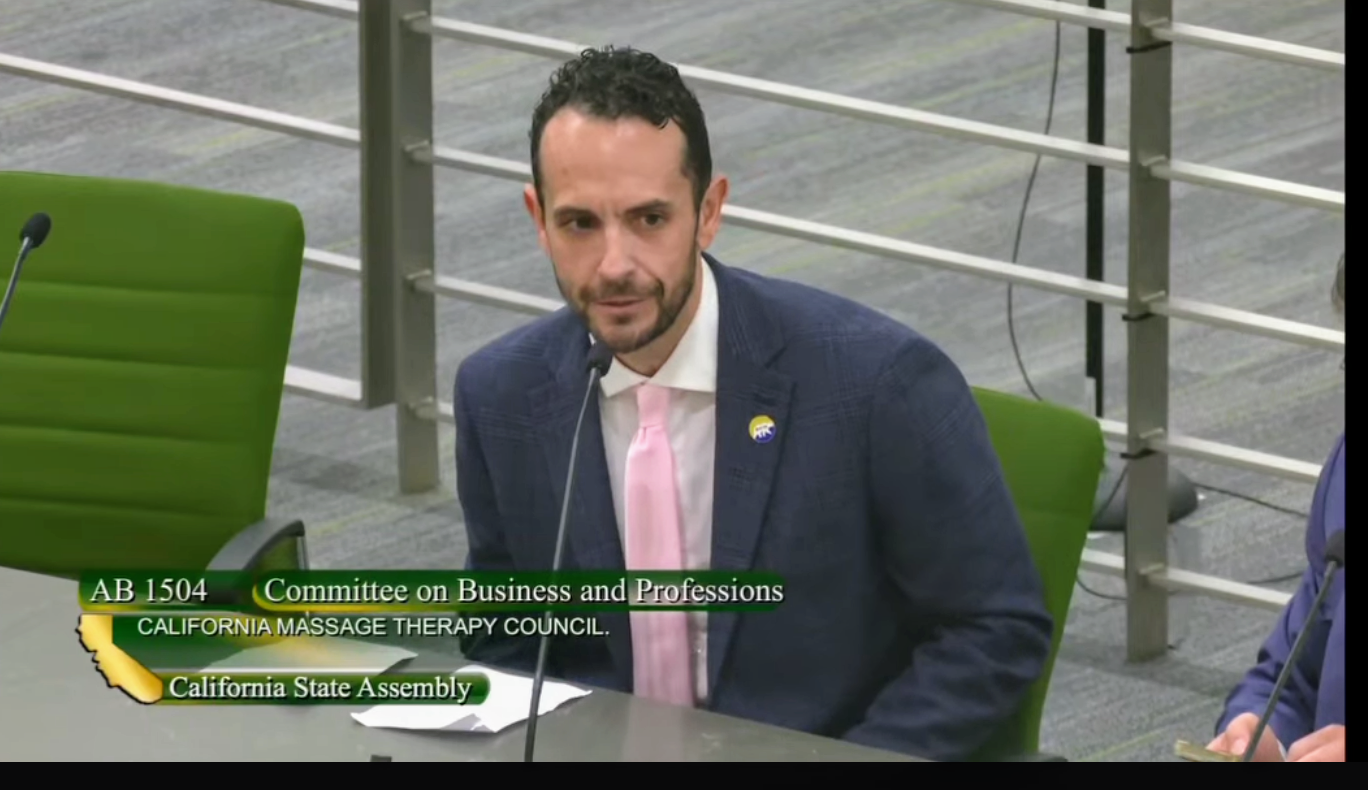
As your government relations team, we are advocating to sunset the CAMTC and establish a full licensure board for our profession. We are working with the California Legislature’s Business and Professions Committee to advocate for a short extension to the CAMTC, as opposed to a full four-year extension. This will signal the legislature’s willingness to explore winding down the CAMTC and replacing it with a licensing board for our profession. If this does not happen during this session, we will still press for sunrising a mandatory licensing board for massage therapy.
Please note that we are in the early stages of this movement, and the specifics are still being developed.
If you are against moving towards mandatory licensure, please let us know your concerns and what it would take to get you to support licensure. We are your professional association and want to make sure your voice is heard.
State Legislation
The AMTA California Chapter, with the guidance and leadership of National AMTA, are in alignment to move towards a mandatory licensure over a voluntary certification process. This would put California in line with the vast majority of the rest of the country. We believe this is the crucial step forward for our profession and the safety of our patients and clients.
Why Should Massage Therapists Want a Mandatory State License
California has 482 municipalities (cities), 58 counties, and 256 cities, (just over half of them), currently require CAMTC (California Massage Therapy Council) for you to be a Certified Massage Therapist, to legally work within their cities. That means anyone in those 226 cities can call themselves a “massage therapist” and it is totally legal. No education, training, or requirements are necessary to practice massage, be it actual massage or under the guise of sex work and human trafficking.
additional links to useful information and websites
Background And History

-
Advocacy 101
Advocacy involves actively supporting a cause, idea, or policy.
-
Understanding the Legislative Process
Explore the legislative process so you can engage more effectively.
-
Regulation & Licensing
Why the qualifications needed to practice effectively and safely.
-
State Regulations
Regulation and license requirements for each state so you can practice legally.
-
AMTA News Feed
Stay up to date on the latest news in the massage therapy profession.
-
AMTA Legal Disclaimer
AMTA Website Terms of Use.